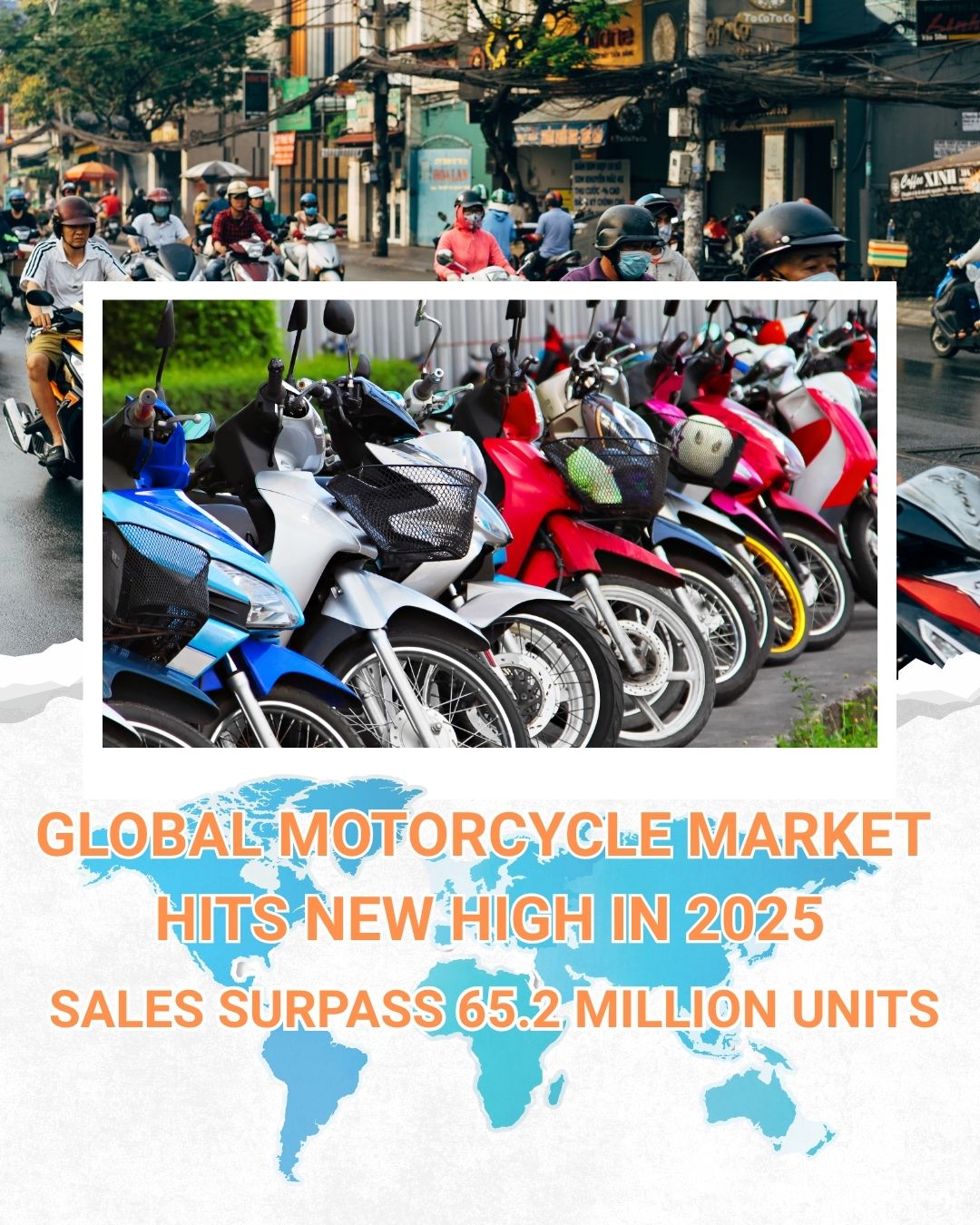
In 2025, the global motorcycle market reached a historic milestone, with total sales climbing to 65.2 million units—an increase of 4.7% compared to 2024. This growth signals a strong and sustained recovery following the disruptions caused by the pandemic, reflecting renewed consumer confidence and stable demand across key regions.
The expansion of the market has been largely driven by emerging economies, particularly in India, Latin America, and the ASEAN region. These markets continue to benefit from favorable demographic and economic conditions, including rising disposable incomes, rapid urbanization, and a growing young population seeking affordable and efficient transportation solutions.
India maintained its position as the world’s largest motorcycle market in 2025. Despite a reduction in government subsidies for electric vehicles, the country still recorded a steady growth rate of 3.6%. This resilience highlights the enduring demand for two-wheelers as a primary mode of transport, especially in densely populated urban areas where motorcycles offer convenience, cost-efficiency, and mobility.
Latin America emerged as the fastest-growing region, posting an impressive 20.7% increase in motorcycle sales. This surge can be attributed to economic recovery, improved consumer purchasing power, and the growing need for personal mobility in cities with limited public transportation infrastructure. Countries such as Brazil, Colombia, and Argentina played a key role in driving this upward trend.
The ASEAN region also demonstrated solid performance, with a collective growth rate of 4.7%. Motorcycles remain deeply embedded in the daily lives of consumers across Southeast Asia, serving both personal and commercial purposes. The continued demand in countries like Indonesia, Vietnam, and Thailand underscores the region’s importance as a core market for the global motorcycle industry.
In North America, the market experienced moderate growth of 4.2%, largely driven by strong performance in Mexico. However, this growth was partially offset by declines in the United States and Canada, where shifting consumer preferences and economic uncertainties impacted sales. While the region remains relatively stable, its growth trajectory is less dynamic compared to emerging markets.
Conversely, Europe faced notable challenges in 2025. Western Europe saw a significant decline of 10.6%, while Eastern Europe experienced an even sharper contraction of 26.6%. These decreases can be linked to economic pressures, regulatory changes, and a shift toward alternative modes of transportation, including electric mobility and public transit solutions.
Other Asian markets—including China, Taiwan, Japan, and South Korea—also reported declines. Factors such as market saturation, aging populations, and evolving mobility trends contributed to weaker demand in these regions. In particular, the transition toward electric vehicles and stricter environmental regulations have begun to reshape the competitive landscape, posing both challenges and opportunities for manufacturers.
Overall, the global motorcycle market in 2025 reflects a clear divergence between high-growth emerging markets and more mature, slower-growing regions. While challenges remain in developed economies, the strong performance in key growth markets continues to drive the industry forward. Looking ahead, innovation, electrification, and adaptability to regional demands will be critical for sustaining long-term growth in the global motorcycle sector.